Wedding and event photography runs on timing, trust, and instinct. You get one shot at moments that won’t repeat. The heavier lift starts after the event.
Thousands of images. Tight deadlines. Endless sorting, editing, and client follow-ups. For years, this was just part of the job, manual, repetitive, and time-consuming.
That’s where AI comes in.
Not to replace the photographer’s eye, but to back it up. From culling and editing to albums and client communication, AI streamlines post-shoot work. Faster decisions. Cleaner workflows. More time for what matters.
The shift is quiet, practical, and hard to ignore. In this blog, we will discuss how AI is reshaping wedding and event photography workflows and why it’s becoming a real edge.
TL;DR
- AI automates post-event work like sorting, delivery, and photo discovery, saving hours of manual effort.
- Guests find their photos instantly using face recognition, without scrolling, logins, or follow-ups.
- Photo delivery is moving closer to real time, keeping engagement high while events are still fresh.
- Built-in privacy and analytics help photographers meet expectations and make smarter business decisions.
- Tools like TurtlePic bring these AI workflows together in one place, making scaling easier without burnout.
10 Ways AI Is Changing Wedding and Event Photography Workflows
Here are ten practical ways AI is reshaping how wedding and event photographers manage their workflows, from post-shoot processing to final delivery:
1. AI Is Eliminating Manual Photo Sorting at Scale
After a wedding or large event, photographers often return with thousands of images captured across multiple cameras and lighting conditions. Before editing even begins, hours are spent organizing folders, renaming files, and tagging photos just to create order.
AI changes this starting point.
Instead of manually sorting, photographers upload the full set and let AI automatically group images by people, scenes, and moments. What once took hours now happens in minutes.
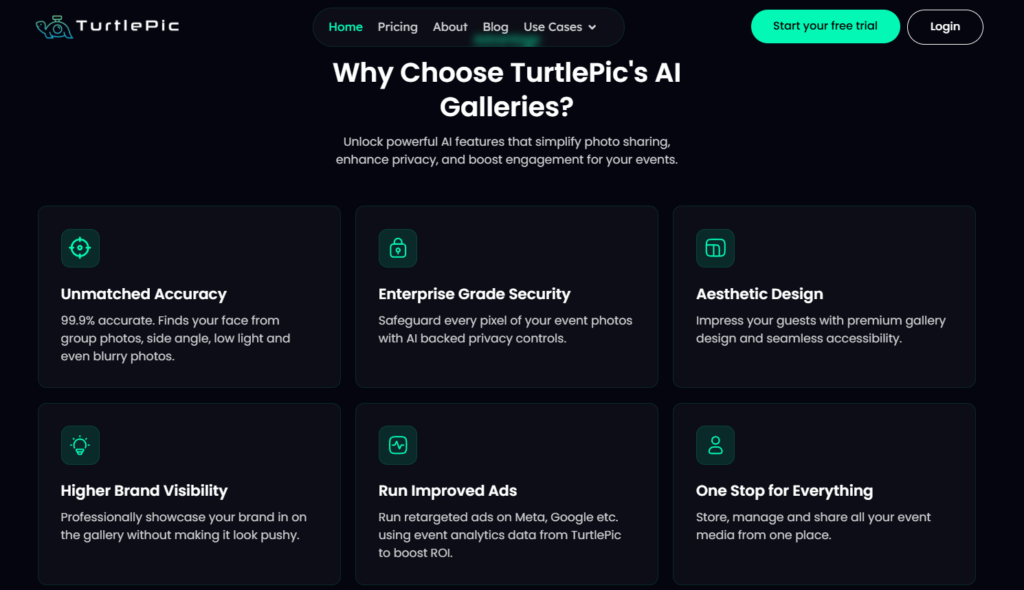
For example, at a large event with hundreds of guests, platforms like TurtlePic use face recognition to match guests with their photos across group shots, side angles, and low-light frames, without any manual tagging.
The outcome is a structured, ready-to-use gallery. Guests find their photos instantly, and photographers skip the most repetitive part of post-event work. At scale, this shift saves significant time and makes high-volume event workflows far easier to manage.
2. Face Recognition Is Redefining How Guests Find Their Photos
Guests once had to scroll through massive galleries to find their photos; a slow, often frustrating experience. AI-powered face recognition removes that friction. Guests upload a selfie and instantly access only the photos they appear in, with no searching required.
At weddings, conferences, and large corporate events, platforms like TurtlePic match guests to their photos across group shots, side angles, and low-light images, without apps or logins. The experience feels personal for guests and effortless for photographers, while dramatically reducing follow-ups and support requests.
At scale, galleries stop being shared folders and start feeling tailor-made.
3. Photo Delivery Is Moving From Post-Event to Real-Time
Photo delivery was traditionally a post-event task, often completed days or even weeks after the event ended, when guest excitement had already dropped.
AI is reshaping that timeline by enabling photographers to upload and publish photos during the event itself. As images go live, guests can access their photos immediately, while the experience is still fresh and share-worthy.
At conferences, festivals, and large weddings, platforms like TurtlePic allow guests to register through a QR code and receive instant notifications when their photos are published, without any manual sharing or follow-ups.
For hosts and photographers, this turns photo delivery into part of the live event experience, driving higher engagement without adding operational overhead.
4. Guest Experience Is Becoming Part of the Photographer’s Workflow
Guest experience was never traditionally part of a photographer’s workflow. Once photos were delivered, the job was considered done. AI-powered platforms are changing that by removing friction on the guest side without adding work for photographers. Logins, endless scrolling, and manual photo requests are replaced with simple, guided access to personal galleries.
Using AI-driven tools, guests can access their photos instantly through QR codes or face recognition, without needing apps or accounts. The experience feels seamless, while photographers avoid repeated follow-ups and support messages. What used to be a separate, often frustrating step for guests is now built directly into the photography workflow.
5. AI Is Reducing Photographer Follow-Ups and Admin Work
After an event, photographers often spend more time answering messages than editing photos. Guests ask where their images are, whether they’ve been uploaded, or if a specific photo can be reshared.
AI reduces this friction by making photo discovery self-serve. Once images are published, guests can find their photos on their own, without reaching out or waiting for manual responses. With AI-powered galleries like TurtlePic, access is structured from the start. Guests are notified automatically and guided to their personal photo sets, which eliminates most follow-up questions before they’re even asked.
The result is a quieter inbox, fewer distractions, and a workflow that stays focused on creative work instead of coordination.
6. Privacy Controls Are Now Built Into Photo Discovery
As event photo sharing becomes faster and more accessible, privacy expectations have risen just as quickly. Open galleries may be convenient, but they often expose images to people who were never meant to see them.
AI addresses this by embedding privacy directly into how photos are discovered. Instead of browsing a public gallery, guests only access the photos they appear in, with controls managed automatically rather than manually.
With AI-powered platforms like TurtlePic, photographers can:
- Ensure guests see only their own photos
- Control downloads and image quality with minimal effort
- Meet privacy requirements for weddings, corporate events, and private gatherings
7. AI Is Helping Photographers Scale Without Burning Out
Back-to-back weddings or large events can quickly push photographers into long nights and compressed delivery timelines. The creative work stays the same, but the volume keeps rising.
AI eases this pressure by removing repetitive post-production and delivery tasks that traditionally consume the most time. Sorting, discovery, sharing, and guest coordination happen automatically, even as event sizes grow. With AI-powered workflows, photographers can handle higher volumes without extending workdays or sacrificing quality.
8. Integrated AI Workflows Are Replacing Multiple Disconnected Tools
For years, photographers have managed their work across multiple tools, one for editing, another for storage, and separate platforms for sharing and communication. While functional, this setup often creates friction and unnecessary handoffs.
Integrated AI workflows are changing that by bringing these steps together. Sorting, organizing, sharing, and managing access now happen within a connected system, reducing context switching and manual coordination.
As event volumes grow, photographers are moving toward workflows that are simpler to manage, easier to scale, and designed to work as a whole rather than as a collection of parts.
9. AI Is Enabling Data-Driven Decisions for Photography Businesses
Photography decisions have traditionally been guided by intuition and experience, with little visibility into how clients actually interact with delivered photos.
AI changes that by adding meaningful analytics into the workflow. Photographers can now see which photos are viewed the most, how often galleries are accessed, and what type of content drives engagement.
These insights help photographers understand what resonates with clients, refine their delivery approach, and make more informed marketing decisions, without relying on guesswork.
10. AI Is Shifting the Photographer’s Role From Operator to Experience Creator
Photography work has long extended beyond the camera. Managing files, coordinating delivery, handling requests, and solving access issues often pulled photographers into operational roles.
AI reduces operational load by automating repetitive and administrative tasks in the workflow, freeing photographers to think more intentionally about how their work is experienced.
This shift allows photographers to focus less on managing processes and more on shaping moments, how stories are captured, how photos are presented, and how clients and guests engage with them long after the event ends.
Conclusion
AI has already made a meaningful impact on wedding and event photography workflows by speeding up sorting, simplifying delivery, and improving how guests experience photos. What once required hours of manual effort is now handled automatically.
If your workflow still depends on outdated processes and constant manual work, it may be time for a change. TurtlePic helps streamline photo sharing, guest access, and privacy in one place.