You crossed the stage. Someone handed you a diploma. Two photographers in black suits captured the moment and now you’re being asked to pay $44.99 for a single digital image of it.
GradImages is expensive because of how their business model is structured: they photograph commencement ceremonies for free and then sell the resulting photos back to graduates at a premium, with no competition at the point of sale. The university paid nothing, so the cost gets passed entirely to students and families. In 2026, that pricing structure is very much still in place.
This post breaks down exactly what GradImages charges, why the model persists, what the reviews say, and what universities are starting to do differently.
What Does GradImages Actually Charge in 2026?
A single digital image from GradImages costs $44.99. Their Premium Download package which includes a photo story slideshow is priced at $99.99, and the Premium Download bundled with two 5×7 prints starts at $114.99. These are the prices listed directly on GradImages’ digital downloads page in 2026.
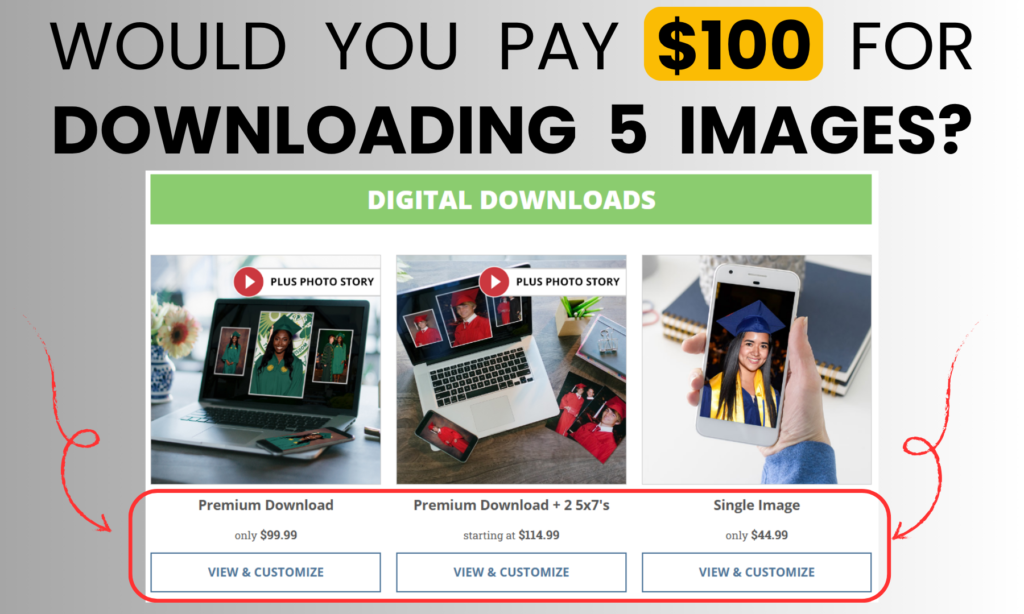
Here’s what the pricing structure looks like in practice:
| Product | Price (2026) |
| Single Image (digital download) | $44.99 |
| Premium Download | $99.99 |
| Premium Download + 2 5×7 prints | from $114.99 |
| Touch-up add-ons (glare removal, whitening) | $19.99–$25.99 each |
The registration program offers a 20% discount on orders over $50, which sounds like a deal until you realize you need to spend $50 before the discount kicks in. Coupon codes circulate online, but the ones that reliably work typically knock $5 to $8 off an order, not the $40–$50 that would make the pricing feel reasonable.
The frustration isn’t just the sticker price. It’s that digital photos which cost nothing to replicate are priced as premium items with add-ons tacked on at every step.
The Business Model That Makes $45 Digital Downloads Possible
GradImages doesn’t charge universities a photography fee. They shoot the ceremony for free, then sell the resulting images directly to students and their families.
This model dates back to the 1970s, when commencement photography entrepreneurs recognized that no one else was systematically capturing graduation ceremonies. Universities had no internal solution and no budget for it, so outside companies stepped in with a simple offer: we’ll photograph your ceremony at no cost to you, and we’ll handle everything afterward. The universities said yes. The companies made their money from the students.
It worked because graduates and more importantly, their parents were willing to pay a premium for a photograph of one of life’s most significant moments. The emotional value of the product is real. The pricing takes full advantage of it.
What makes this model especially durable is that the photographer is hired by the university, not by the student. The student has no say in who photographs the ceremony, no ability to bring their own professional photographer onto the stage, and no alternative provider. By the time a graduate sees the watermarked proof in their inbox, the only choice is whether to pay GradImages or go without.
This is textbook captive-market pricing and it’s legal, common, and very difficult to opt out of.
Why Your University Won’t Switch (Even If Students Hate It)
GradImages holds multi-year exclusive contracts with thousands of universities and high schools across the US and Canada. According to their own materials, they photograph over 1.8 million graduates annually across 6,000+ commencement events each year.
For a university commencement coordinator, switching vendors means:
- Issuing a new RFP and evaluating bids
- Retraining staff on a new system
- Explaining the change to graduates and families accustomed to the GradImages email
- Assuming risk if the new vendor underperforms on the day
The complaints about GradImages come from students and families not from the commencement office, which is the decision-maker. As long as the ceremony runs smoothly and photos get delivered, the coordinator’s job is done. The pricing friction happens downstream, after the contract is already signed.
This isn’t unique to GradImages. It’s how most institutional vendor relationships work. The buyer (university) and the end user (graduate) have different priorities, and the vendor is optimised for the buyer’s needs, not the user’s.
Is GradImages Worth It? What the Reviews Say
Based on the reviews, most graduates and families feel the value doesn’t match the price.
On PissedConsumer, GradImages holds a 1.1 out of 5 stars based on over 60 verified reviews as of mid-2025. Complaints cluster around four issues:
- Pricing opacity – add-ons and package upsells make it hard to know the final cost before checkout
- Photo quality – blurry or low-resolution images that don’t meet standard print sizes
- Delivery failures – orders that never arrived or arrived damaged in unprotected envelopes
- Customer service – a published phone number that connects to the wrong company, slow email responses, and a refund process that requires the customer to pay return shipping first
On Reddit, the sentiment is similarly consistent. Threads across multiple university subreddits – Ohio State, Georgia Tech, University of Central Florida, all surface the same frustration: paying $44.99 for a digital image of a moment the graduate technically already lived and paid tuition to reach.
That said, GradImages does deliver something real. The photographers are trained specifically for commencement conditions. Photos are matched to individual graduates using their GradTrak system but this raises a real privacy concern: anyone can look up a graduate’s photos using just their last name, school, and graduation year, all information that’s publicly available or easy to guess. In an era where personal photo access should require consent, not just a surname, that’s a significant gap that’s hard to overlook.
The problem is that the price-to-quality ratio is inconsistent, the pricing model is opaque, and there’s no real alternative for most graduates at the point of purchase.
What Are the Alternatives to GradImages?
The GradImages model works the way it does because universities weren’t previously offered a better option. That’s changing.
Modern AI-powered photo platforms deliver graduation and convocation photos in a fundamentally different way. Instead of the shoot-for-free, charge-the-student model, these platforms work directly with universities on a simple subscription – monthly, quarterly, or annual at a cost that’s a fraction of what students collectively end up paying GradImages per ceremony.
The difference goes beyond pricing. These platforms are built to handle terabytes of event photo data securely, giving universities the infrastructure to offer premium, branded galleries to every graduate. Students can download, share, and relive their ceremony photos freely which naturally drives the kind of user-generated content that benefits the university’s own brand.
Privacy is handled at the institutional level too. Universities can choose between full-access gallery links where anyone with the link can browse all photos or restricted access links where students can only see photos they personally appear in, verified through face recognition. No more searching by last name. No more strangers browsing a graduate’s photos.
The integration goes further. These platforms can connect directly with a university’s own website, so alumni and current students can visit the institution’s gallery, search for their photos instantly using face recognition, and download them in seconds without scrolling through thousands of images, without creating an account on a third-party platform, and without paying a cent.
The way it works: photographers capture the ceremony as normal, uploading photos to the platform in bulk. At the event, graduates scan a QR code, take a selfie, and the platform’s face recognition technology, typically accurate to 99%+, returns only the photos of that specific person from the full album. No scrolling through thousands of images. No watermarks. No $44.99 downloads.
Platforms like TurtlePic are built specifically for high-volume events like convocations, where photo delivery at scale is the challenge. TurtlePic requires no app download, works on any device, and supports university-branded galleries so the photo experience carries the institution’s identity rather than a third-party vendor’s logo.
For a deeper understanding, feel free to book a 15-minute demo call.
Frequently Asked Questions
How much does GradImages charge per photo in 2026?
A single digital image from GradImages costs $44.99 in 2026. Their Premium Download package is priced at $99.99, and the Premium Download bundled with two 5×7 prints starts at $114.99. Add-on fees for touch-ups such as glare removal and whitening are charged separately at $19.99–$25.99 each.
Can I get my GradImages photos for free?
There is no official way to get GradImages photos for free. GradImages does send free low-resolution proof previews after the ceremony, but full-resolution downloads and prints require purchase. Pre-registering before commencement day unlocks a 20% discount code for orders over $50, which is the most reliable discount available.
Why does my university use GradImages?
Most universities use GradImages because GradImages photographs the ceremony at no cost to the institution. The university signs a contract, GradImages covers the photography, and all revenue comes from student and family purchases after the fact. For commencement coordinators, it’s a budget-neutral solution — the pricing friction graduates experience happens after the institutional contract is already in place.
Is there a GradImages discount code that works in 2026?
The most reliable discount is the 20% off code triggered by pre-event registration on the GradImages website. Third-party coupon codes circulate online, but most offer modest savings of $5 to $8 on qualifying orders. Waiting for post-graduation promotional emails from GradImages can also yield price drops, though delivery timing varies.
What happens if I don’t order from GradImages?
Nothing, there’s no obligation to purchase. GradImages sends proof previews, but buying is entirely optional. If your university used GradImages as the official photographer, they own the images and no other vendor can legally sell them to you. Family members’ photos taken from the audience remain their own.
Are there universities that offer free graduation photos?
Some universities are shifting to AI-powered photo delivery platforms like TurtlePic that provide photos to graduates at no individual cost, funded as part of the event budget rather than passed on per-photo to students. This model is more common outside North America but is growing in adoption. If this is something you’d like your university to offer, it’s worth raising with your commencement or student affairs office.
The Bottom Line
GradImages is expensive because the university, not the graduate, is their customer and the model has had no real competitive pressure for decades. The pricing isn’t accidental. It’s structural.
In 2026, universities do have genuine alternatives. Platforms that use AI face recognition to deliver photos instantly to every graduate without per-photo charges, watermarks, or opaque add-ons already exist and are in use at institutions across multiple countries.
If you’re a university commencement or event coordinator evaluating photography vendors, see how TurtlePic handles convocation photo delivery and what a student-first photo experience looks like at scale.